

Nederlandse versie hier.
Since mid-January, I’ve been working on my preliminary research for a new textile animation. Just like in A Story of Unfolding Wings, I want to create a stop-motion animation composed of woven frames. But this time, I’ll be using more complex patterns and color transitions, along with finer yarn, so I can create a more delicate, zoomed-out image. I’m also exploring ways to deepen the storyline, develop a scenario, and figure out how to translate that into woven frames.
In the first phase of my research, I primarily wove the four canvases that will serve as the material for the course of the research. Below, I describe the process and the meaning I currently see in each canvas. I created one or two clips for each canvas. For the canvas I wove at New Order of Fashion, I created five clips. After the summer, I’ll convert the remaining frames into animation.
Cloth 1 – Sea
16/2 cotton, 101 x 14.5 cm, 80 frames; clip 20 frames.
My primary focus when creating this cloth was to bring to life a pattern from a weave in my Weaving Glitches research. I succeeded, but it gave me more than that. The cloth took on distinct meaning when I showed the clip to Tess Martin, from whom I had taken two coaching sessions on animation techniques and storytelling. She saw water in the clip, the sea, the glistening waves. Water that rises and recedes. That’s what I keep seeing now, and it fits with my work in which I often reference the sea. The clip is only a part of the piece, the right-hand frames at the top of the fabric. So I still have the top left section and the entire bottom section left to work on. There’s still a lot of water to be found, especially at the bottom.

Cloth 2 – Analog TV Noise
16/2 cotton, 118 x 17 cm, 96 frames; clips of 12 frames each.
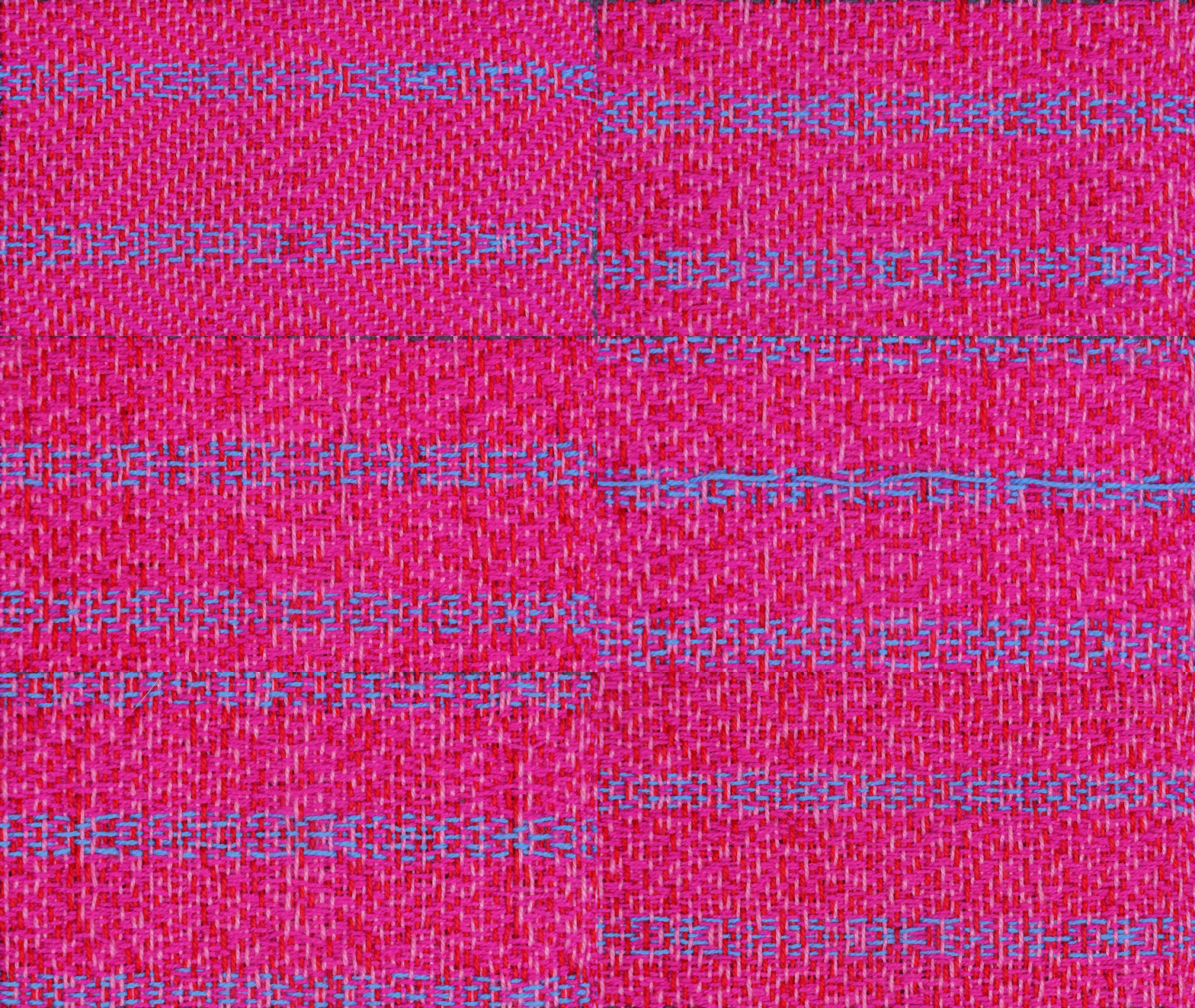
Another recurring theme in my work is glitches, in this case the static noise on old analog televisions. Even as a child, I was fascinated by how the images from the channels would distort when you turned the tuning knob just outside the channel’s range. I often compare glitches to my transgender identity and my neurodiversity, which deviate from the norm. It is the common thread running through my weaving art, my earlier media art, and my life. I wove this piece on the computer-controlled handloom at New Order of Fashion. By keeping a horizontal bar fairly constant within the frames and introducing a kind of static to the rest of the image, an image emerges that is more similar to tuning around a channel on an analog television than I had expected when I was weaving it. In one of the clips, Tess saw something that looked like a talking mouth, so I’m going to play around with that!

Cloth 3 – Textures and a Moving Head
16/2 cotton, 102 x 33, 80 frames; clips 8 and 12 frames.
I wove the third cloth on the TC2 at cre-A-ctief in Friesland. The TC2 is a computer-controlled Jacquard handloom. The main difference from a conventional handloom is that the heddles through which the warp threads are threaded can be raised or lowered individually for the weft, whereas on a conventional loom you raise or lower the heddles per shaft. This allows you to weave images, such as in the first clip where my head seems to be pulled back and forth by a ball. It was actually a rose that I let descend in stages, creating a surprising effect. The second image is a test using my own patterns as I use them in my other weaves, but in the way you create or program patterns and gradients in an image-editing program for the TC2. It was valuable to experience the pros and cons of this loom and its working methods firsthand. And it’s nice to see that my style holds up even on a Jacquard loom.

Cloth 4 – Rainbow Swipe
16/2 cotton, 104 x 33.5, 48 frames (but maybe double that); clip 24 frames.
Even before I wrote the application, something inside me wanted to create a rainbow swipe. Maybe it was my inner child, who hardly ever drew rainbows when I was little, or my fascination with color. Probably both. But it was also a challenge in terms of planning. Each square consists of 16 x 16 threads, and I wanted to repeat a pattern of eight different textures. Weaving 24 images separately felt like a waste, so I devised a method in which I wove eight sections, each comprising three frames. I expect I’ll be able to get more clips out of the fabric than the two pre-planned diagonal Rainbow Swipes.
Next Phase
In September, I’ll continue with the research, which has been somewhat delayed, mainly due to a lack of time caused by my other weaving research and other aspects of my weaving practice. Still, I feel satisfied with where I am right now. For me, the images already speak for themselves. The first challenge is to create a narrative using the material I’ve collected and the clips I’m still making from the canvases mentioned above, so that I can produce a concept trailer for a follow-up grant application. And then to develop the screenplay, the concept for the textile animation I would ultimately like to weave.

This research project received financial support from Creative industries fund, through its Kick-start Grant.

TS-DOEK1-FRONT-RIGHT

TS-DOEK2-NOOF-FRONT-P1-LEFT

TS-DOEK2-NOOF-BACK-P1-LEFT

TS-DOEK3-TC2-ROOS-FRONT

TS-DOEK4-RAINBOW-FRONT

TS-DOEK2-NOOF-BACK-P2-LEFT

TS-DOEK2-NOOF-FRONT-P2-RIGTH
TS-DOEK2-NOOF-BACK-P2-RIGHT

TS-DOEK3-TC2-STRUCT-FRONT