
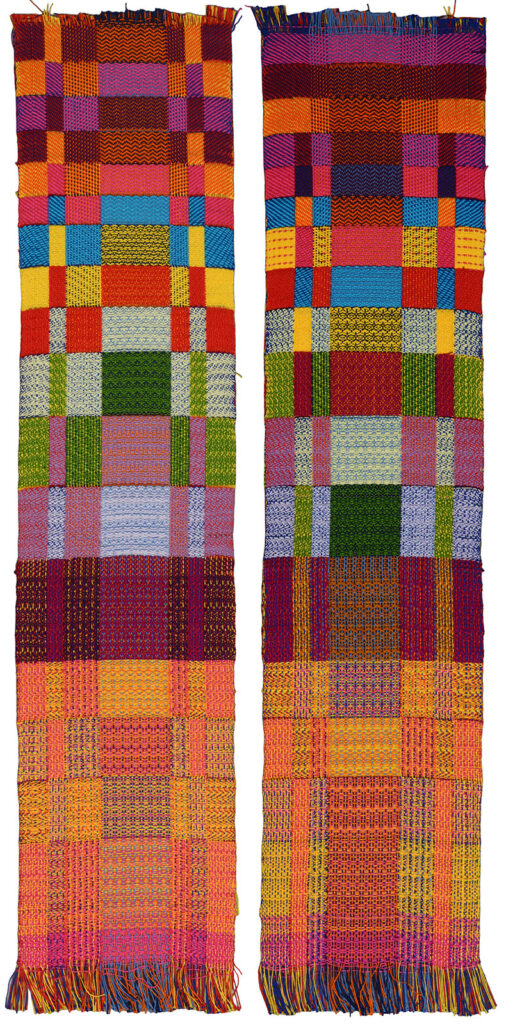

Three layers, 18 x 80 cm, 8/2 cotton, mid-February – May.
Nederlandse versie hier.
For the second cloth, I decided to weave in three layers. Twenty-four shafts in two blocks meant I could use a maximum of four shafts per layer. My brain had to work even harder, because three layers mean even more calculations and drafting. It also means you have to weave more. Each time, you weave one weft per cloth, so in fact I didn’t weave eighty centimeters, but nearly two and a half meters.
I started the weft with simple colors so I could clearly see the block changes. With each block change, I switched one colored thread. In the second half of the cloth, I decided not to switch entire blocks, but to mix the colors thread by thread, or rather, per shaft. In the weft, I didn’t assign a fixed color to each layer per block (one weft forward and one weft back with the same thread), but instead alternated the three colors in sequence.
In all honesty, I have to admit that I stared at some of the blocks several times to see if I could achieve the same effect as with the stereograms or Magic Eye pictures from my teenage years, where you could see an object if you kept your focus long enough.

Working out the intersections for the three-layered blocks was yet another challenge. An extra layer feels like an extra dimension. You don’t just choose whether to place a layer on top or underneath; you also have to figure out which layer goes in the middle. But thanks to Babs’s thorough coaching, my willpower, and my drive to understand the logic, I slowly but surely figured it out. I was able to visualize what was actually happening more and more clearly.
In the first drawing, you can see the layer transitions, how you decide for each weft pattern which layer should go on top, underneath, or in the middle, and how the weft thread switches to a different layer. And alongside that, my first attempt to further break down the layers to “mix” the warp threads, so to speak. In the second drawing, you can see patterns 1416, in which I relied less and less on the paper to program the next variation on the dobby bars.

The Layered Complexities research project received financial support from the CBK Rotterdam through the Impuls en Verdieping program.


