
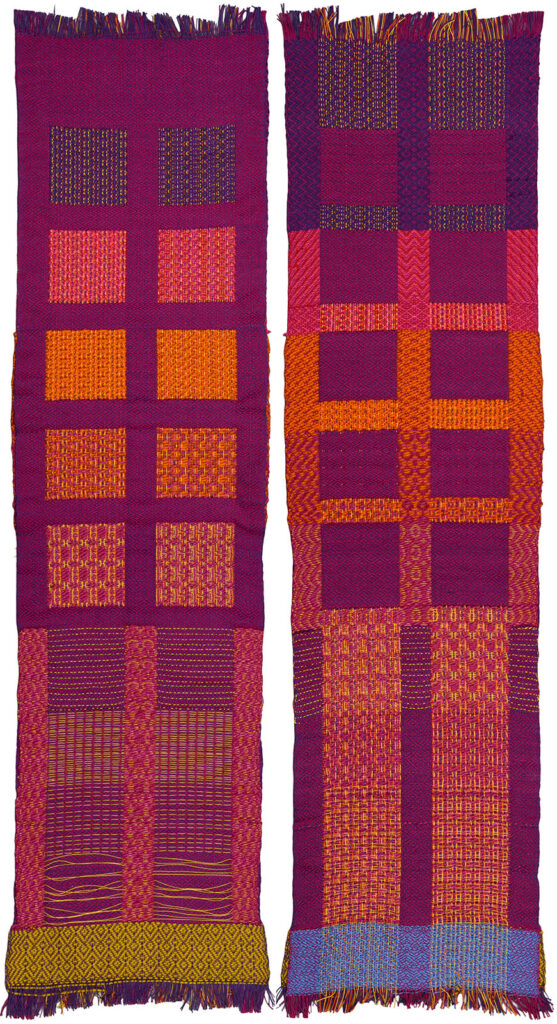
Two layers, 28 x 110 cm, 8/2 cotton, 16/2 cotton, carpet yarn (wool), June–July.
Nederlandse versie hier.
The last piece, like the first weave in this study, was a double weave, but this one consisted of one layer of eight heddles and one layer of four heddles. That way, I could make the most of my love for weaving complex patterns. Here, too, I used two blocks, which meant all twenty-four heddles were in use.
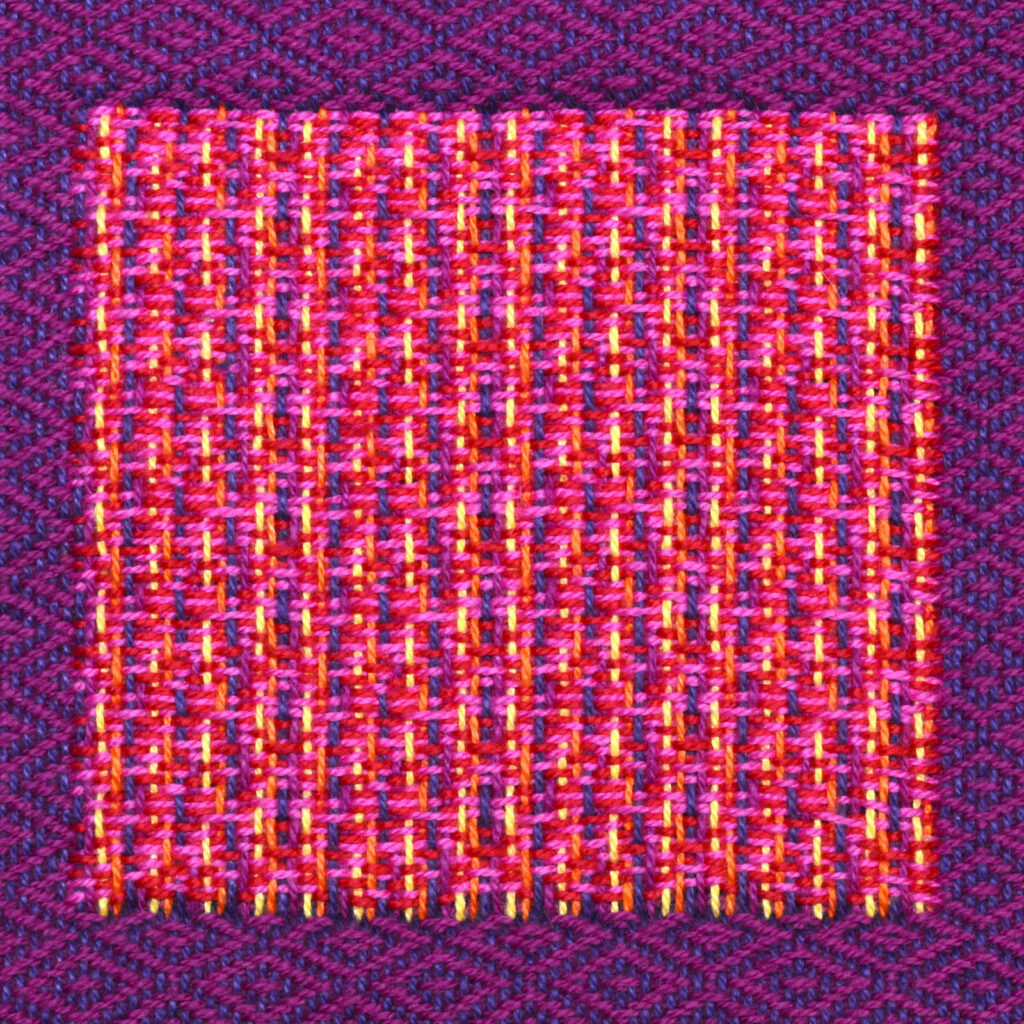
I had planned in advance to arrange the blocks in such a way that I could create openings. As if it were the mask I had worn for so many years. A simple, friendly, and airy pattern behind which much tension or other feelings were hidden, now unmasked so that the inner layers can come to the surface. The morning I wove the first bright pink window, I had a conversation with my psychiatrist, who diagnosed me with ADHD. It made sense to me. My lively, exuberant me was captured in the weave.
After that section, I started experimenting with the thick Klippan carpet yarn I had recently discovered. I compared the thickness of the carpet yarn I used in the eight-shaft layer with the 8/2 cotton in the four-shaft layer, and decided that I needed to alternate between three and two wefts of cotton after each weft with the carpet yarn.
Later, I also added the thinner 16/2 cotton to the complex layer. Finally, I decided to weave this yarn through all the layers. It was similar to mixing threads and layers in the second piece, but with a very specific focus on creating a sort of see-through effect. Instead of bringing the complex layer to the front in the window, I moved it to the bottom. As a result, the complex layer at the top of the fabric ended up on the sides, and I was able to let the thin yellow thread run across the middle section, which now became the mask. You could see it as the mask now being enveloped by reality—the newly discovered or true identity. This is no longer found on just one side of the canvas, but is connected all around it.
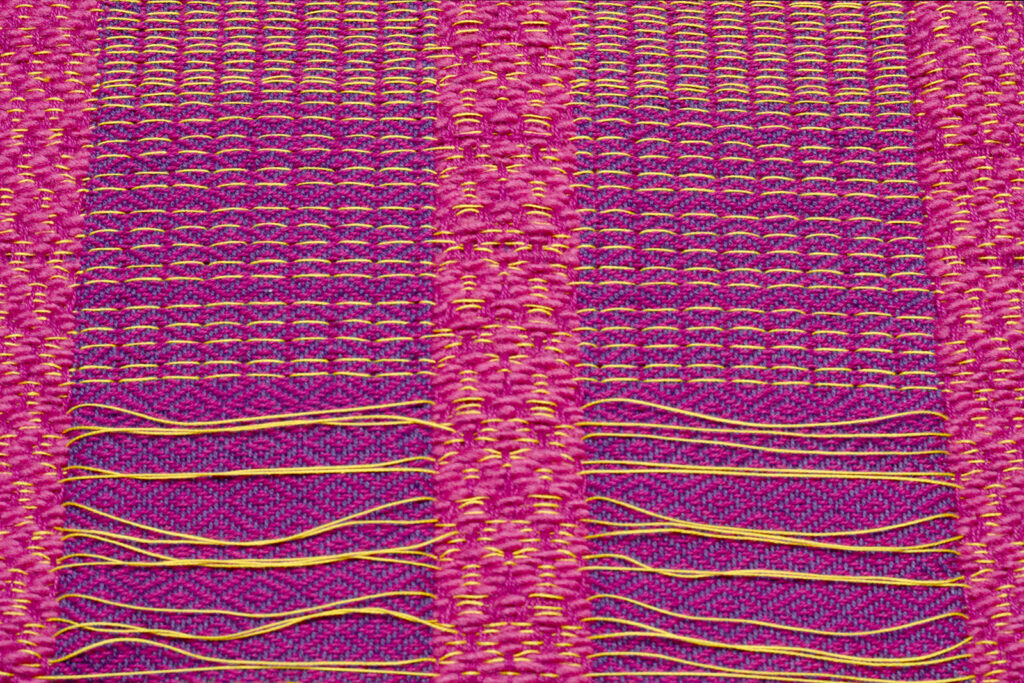
What I loved about this project was that each piece felt like a step up. I kept pushing myself a little further with each challenge. In this third piece, I felt the freedom to experiment with different materials and developed a concept I could weave around, rather than simply creating a piece based purely on technical considerations. Using different numbers of shafts and, in the end, different layers gave me quite a puzzle to solve, but programming the dobby became easier and more intuitive as I went along. I was even able to connect the layers using the thin cotton through live coding. I programmed it without removing the dobby heddles from the loom.
Both during and after weaving this weave, I was surprised by the various patterns and the texture that emerged from mixing different yarn thicknesses. Just like multi-layer weaving, I will definitely play more with this in my future work.

The Layered Complexities research project received financial support from the CBK Rotterdam through the Impuls en Verdieping program.


